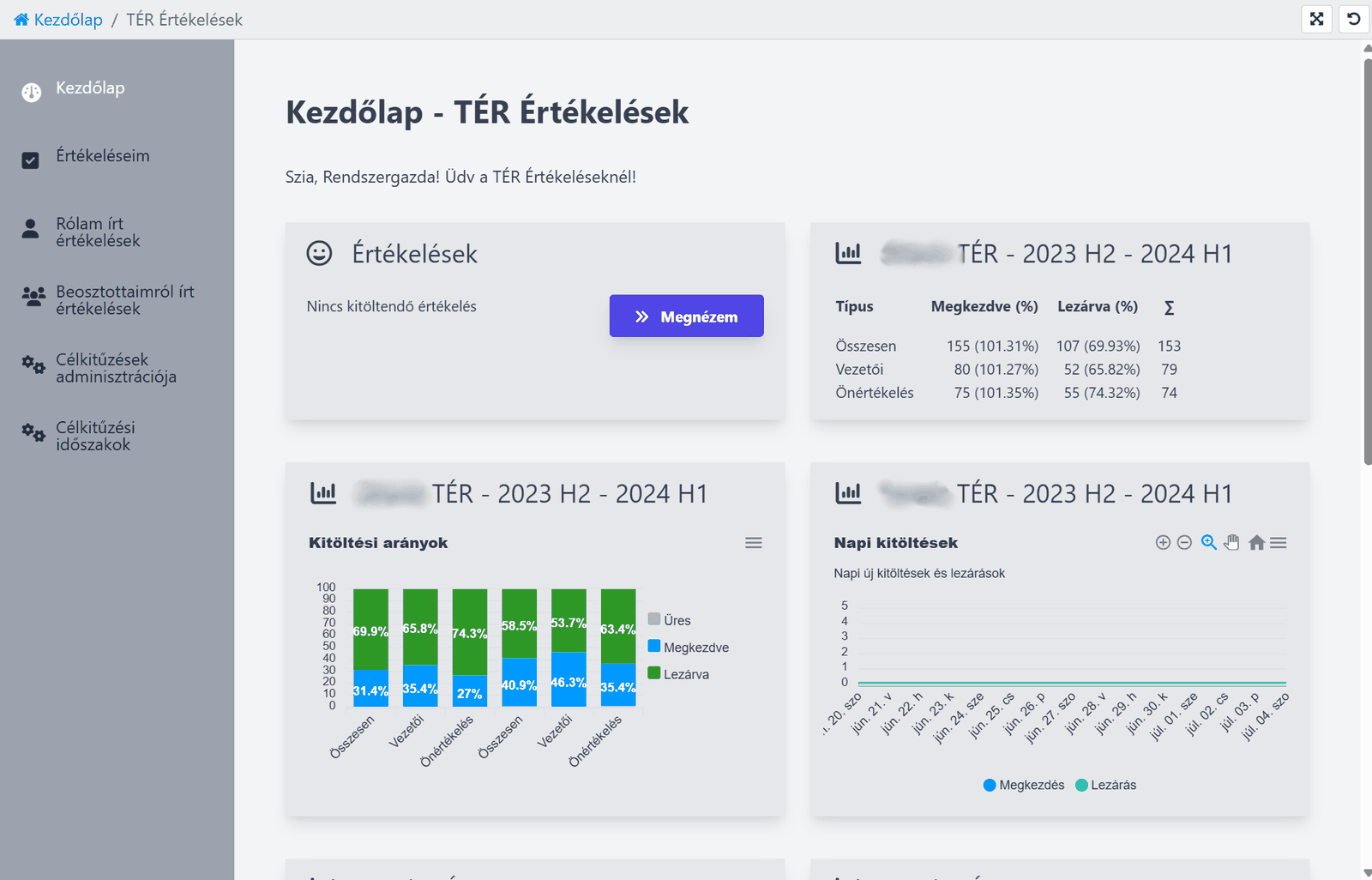
Better management decisions, less guesswork.

Evaluation is not a once-a-year HR event: it happens as often, and as simply, as the operation requires. On one sheet or seventy-five, monthly or twice a year — from the same system.

Today five units, one sheet. Tomorrow a thousand people, monthly. The same system.

The same system, in the cloud or on your own servers — still small today, multiple sites tomorrow

How deep shall we go?

Same system. Three depths.

surface. If you only have a few minutes mid-depth. The essentials, with practical examples deep dive. If you want to see what's behind it

The question isn't whether you review once a year. It's whether you see in time what needs to change.

The life of an evaluation

  1. You build it

    You decide what you want to see regularly: competencies, goals, a checklist, a metric. That becomes the evaluation sheet — a different one per role if needed.

  2. You assign it

    To whom, who evaluates, by when. Self, manager, direct report, peer — whichever you need, and only those.

  3. They fill it in

    On one screen, no training needed. Meanwhile you see who has submitted and who hasn't.

  4. The result comes in

    On a common scale, weighted, comparable. Not a pile of PDFs.

  5. You see where to step in

    Competency heatmap, development plan — and if a result is an outlier, the manager is notified automatically.

  6. You measure again

    The same sheet, later. Both rounds side by side.

Six steps, one system. Not an annual event.

At a restaurant chain 5 units · instant start

An everyday manager's check became a structured evaluation in twenty minutes: five units to evaluate, one sheet, access for the manager — and off it went.

At a 100–150-person company twice a year · three directions

Self, manager and direct report — and 75 evaluation sheets, one for every role. The same system, a different depth.

At an organisation of 1,000+ monthly · every employee

A monthly evaluation cycle for the whole headcount. Not an annual event — a rhythm.

Not small, medium and large customers. The same mechanics, at a different frequency and depth.

Evaluation that turns into a management decision.

An objective, consistent yardstick — you see who needs what.

Evaluation sheets

Customisable appraisal forms with competencies and scales. Annual, semi-annual or project evaluation.

360° feedback

Manager, self and direct-report evaluation — turned on with a few clicks. More perspectives, a sharper picture that's harder to skew.

Objectives (OKR/KPI)

Individual and team goals. Quarterly/annual goal setting, progress tracking, weighting.

Development plans

Identified development areas, action plans. Linked to the training module.

Metrics

KPIs and other objective metrics, fed in from Excel or via API.

Management reports

Team overview, competency report and results you can compare between cycles — in one view.

500+ job roles evaluated
750,000+ completed evaluations
25,000+ employees evaluated
Assess Result Act Re-measure
Operating model

A review is not an event. It is a loop.

You assess, you see the result, you act, then you measure again — and the next round starts with what the last one taught you.

See the oneLoop operating model →

If you want to go deeper still

Assessment models, campaigns, weighting, scales, 360 directions, frequency and reporting — the whole mechanism.

Take me deeper
0 customer implementations, in manufacturing and office environments
0 active users
0 years of product development
  • Pharma
  • Electronics manufacturing
  • Automotive
  • Banking
  • Energy
  • Public sector
  • Media
  • Training
  • Hospitality

One review a year vs. onePerformance

The question isn't whether a review happened. It's whether it turned into a management decision.

Traditional review Done on paper
  • Once a year, on a form
  • Everyone measures by a different yardstick
  • Feedback stays in a drawer
  • You can't compare one round with the next
  • No view of the whole team
onePerformance Turns into a decision
  • Regular, structured review cycles
  • A single, comparable yardstick
  • 360° feedback – multiple perspectives
  • Results comparable between two cycles
  • A manager dashboard for the whole team

Frequently asked questions

What managers and HR ask most.

How much extra work is this for HR?
Less than a paper round: review sheets are built from templates, participants are emailed automatically, completion is visible while the cycle runs, and the result assembles itself — nothing has to be copied into a spreadsheet.
What is 360° feedback?
The employee is rated not only by their manager but also by themselves, peers and reports – for a more accurate, balanced picture.
What comes out of an evaluation?
A comparable result on a single scale, broken down by competency. A development plan can be recorded alongside it, and the next cycle shows whether anything changed.
Are results comparable across the team?
Yes – with a single yardstick, a manager dashboard shows where everyone stands, no guesswork.
Do I find out if someone's result stands out?
If the review sheet is set up for it, the manager gets an automatic email about a strong or a weak result. The threshold is set per review sheet, and you can ask for the good side, the weak side, or both.
oneStart

Can be up and running within a week.

With an employee list and the job roles at hand, the first review round can start within a week.

Learn more →

Contact

Add your phone number for a quick callback
How should we contact you?

Email address

info@onelearning.info

Postal address

One Learning Zrt.
1021 Budapest, Budakeszi út 51/D, C. ép. II/5

Related solutions

How do we know everyone is prepared?

oneLearning

  • Upload own materials
  • Videos, PDFs, tests
  • See who is where
  • Course creation with exams
Learn more – oneLearning
How do we know the new hire has truly got going?

get-2.work

  • Recruiting: the hired candidate moves to onboarding in one click
  • Documents automatically
  • E-learning materials assigned
  • Task list for the employee
Learn more – get-2.work