How do you know where everyone stands — not just at year end?
Evaluation is not a once-a-year HR event. It happens as often, and as simply, as the operation requires.
Today five units, one sheet. Tomorrow a thousand people, monthly. The same system.
People usually answer these from memory. Then it turns into an argument.
- Where does everyone stand now — not last year?
- What did we tell them last time, and did anything come of it?
- Who needs intervention, and who doesn't?
- Do we ask everyone the same thing — or everyone something different?
- If asked, what did we base the decision on?
The life of an evaluation
-
You build it
You decide what you want to see regularly: competencies, goals, a checklist, a metric. That becomes the evaluation sheet — a different one per role if needed.
-
You assign it
To whom, who evaluates, by when. Self, manager, subordinate, peer — whichever you need, and only those.
-
They fill it in
On one screen, no training needed. Meanwhile you see who has submitted and who hasn't.
-
The result comes in
On a common scale, weighted, comparable. Not a pile of PDFs.
-
You see where to step in
Competency heatmap, development plan — and on an outlying result the manager is notified automatically.
-
You measure again
The same sheet, later. Both rounds side by side.
Six steps, one system. Not an annual event.
What a manager sees
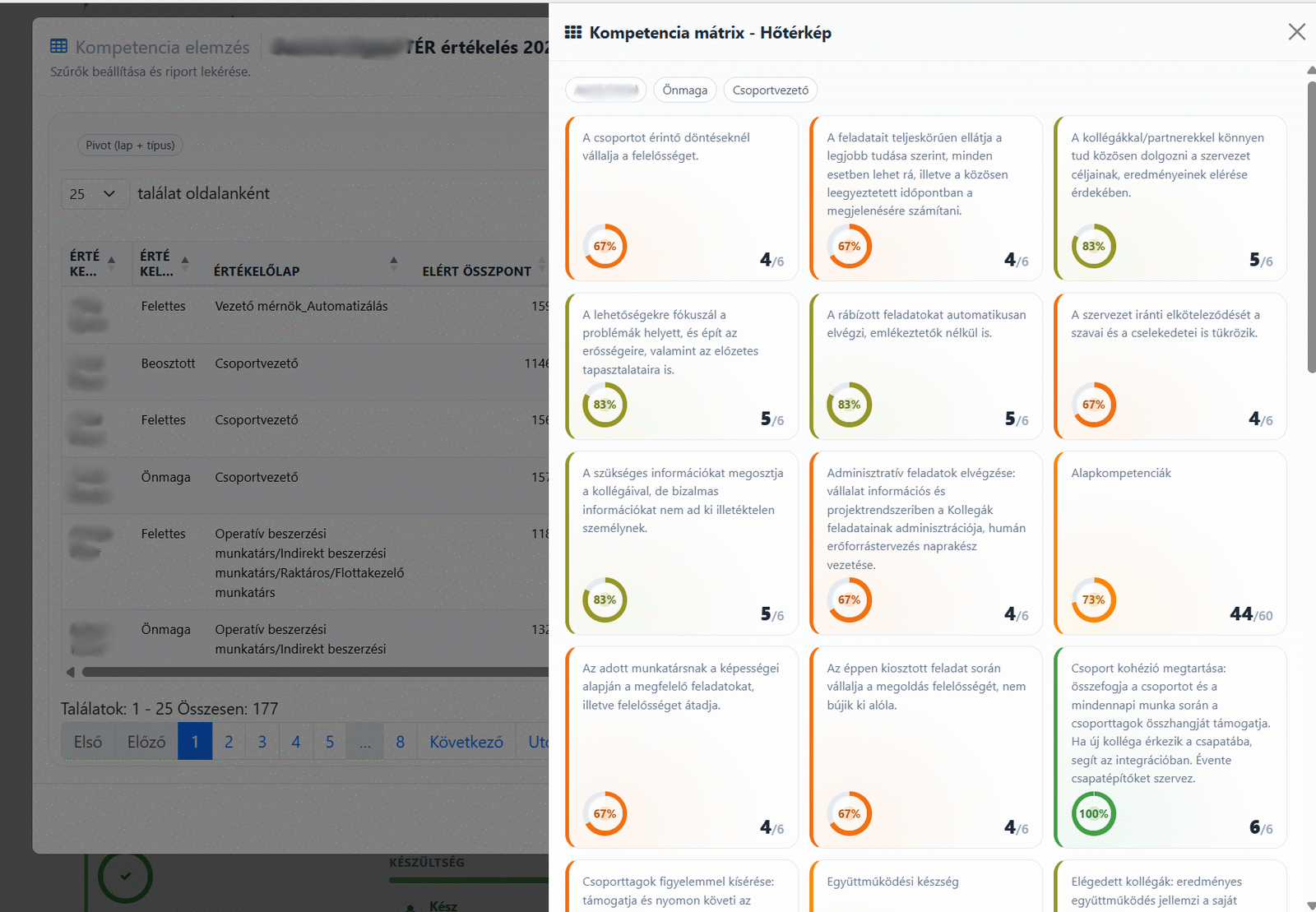
An everyday manager's check became a structured evaluation in twenty minutes: five units to evaluate, one sheet, rights for the manager — and off it went.
Self, manager and subordinate — and 75 evaluation sheets, one for every role. The same system, a different depth.
A monthly evaluation cycle for the whole headcount. Not an annual event — a rhythm.
Not small, medium and large customers. The same mechanics, at a different frequency and depth.