In 30 seconds
Evaluation is not an event
Not once a year, into a drawer. In a rhythm, so the manager sees where a conversation is needed and measures again later.
Evaluation need not be a once-a-year HR event. It can happen as often, and as simply, as the way you work requires.
Today five units, one sheet. Tomorrow a thousand people, monthly. The same system.
In 30 seconds
Not once a year, into a drawer. In a rhythm, so the manager sees where a conversation is needed and measures again later.
How deep shall we go?
Same system. Three depths.
And when several people remember it several different ways, the argument begins.
You build it
You decide what you want to see regularly: competencies, goals, a checklist, a measure. That becomes the evaluation sheet — even a different one per role.
You assign it
To whom, who evaluates, by when. Self, manager, direct report, peer — whichever you need, and only those.
They evaluate
On one screen, no training needed. Meanwhile you can see who has submitted and who hasn't.
The result comes in
On a common scale, weighted, comparable. Not a pile of PDFs.
You step in
Competency heatmap, development plan — and on an outlying result the manager is notified automatically.
You measure again
The same sheet, later. Both rounds side by side.
It can be a simple manager's checklist. It can be a self-assessment plus a manager's review. It can be multi-angle, 360° feedback. The mechanics are the same — the situation sets the depth and the frequency.
An everyday manager's check became a structured evaluation in twenty minutes: five units to evaluate, one sheet, rights for the manager — and off it went.
Self, manager and direct report — and 75 evaluation sheets, one for every role. The same system, a different depth.
A monthly evaluation cycle for the whole headcount. Not an annual event — a rhythm.
Not small, medium and large customers. The same mechanics, at a different frequency and depth.
Not only whether it was filled in. But also where results diverge, where it needs a conversation, and what is worth measuring again later.
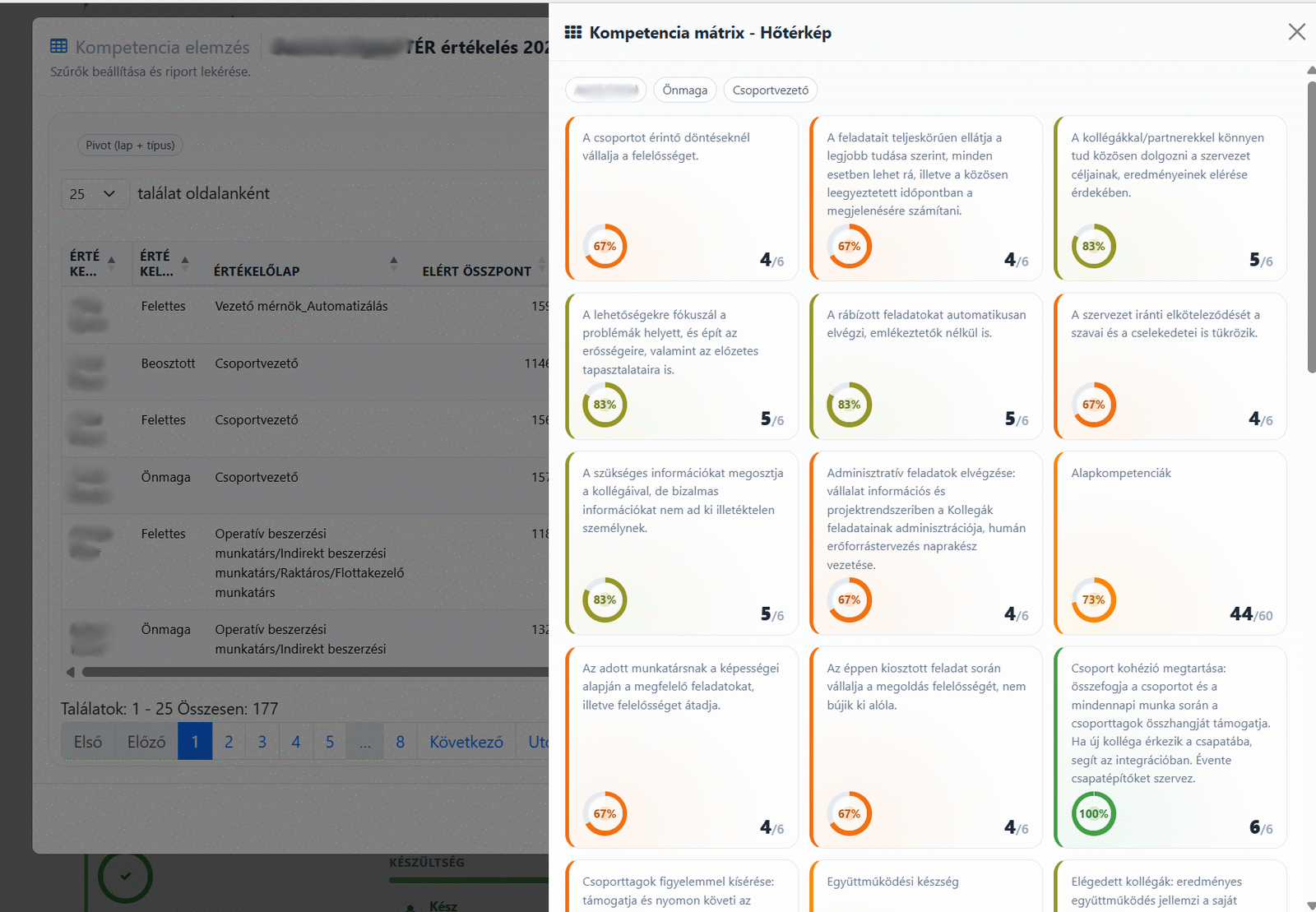
Not an annual event. A feedback loop.